Table of Contents
- Introduction: Lab 180MPa vs Jobsite 100MPa
- UHPC Microstructure: Dense Packing Theory
- 5 Key Parameters of Mix Design
- Fiber Orientation: The Overlooked Variable
- 6 Fatal Construction Mistakes
- Curing Regime: The Final Gate to Strength
- Cost Breakdown: How Much per Cubic Meter?
- Emerging Applications and Future Trends
- FAQ
- Conclusion
Introduction: Lab 180MPa vs Jobsite 100MPa
There is an open secret in the UHPC (Ultra-High Performance Concrete) industry: laboratory standard cylinders easily reach 150-180MPa compressive strength, but at actual construction sites, the same mix often only achieves 100-120MPa, or even lower. This 30%-40% strength loss is not a material problem, but a systemic issue involving mix design, construction practice, and curing regime.
Many engineers simply understand UHPC as "high-strength concrete with lower water-binder ratio, higher silica fume content, and steel fibers," then design mixes following ordinary concrete logic. The result: poor workability, fiber clumping, surface voids, and strength far below expectations. This article systematically breaks down 5 key parameters of UHPC mix design starting from microstructure principles, and identifies 6 of the most common fatal construction mistakes.
Core insight: UHPC is not "better concrete" — it is an entirely new composite material system. Its performance comes from maximum particle packing + hydration at ultra-low W/B ratio + steel fiber bridging toughening. All three are indispensable.
UHPC Microstructure: Dense Packing Theory
The first step to understanding UHPC is understanding "Maximum Packing Density." Ordinary concrete typically has 15%-25% porosity, while UHPC can achieve porosity as low as 2%-5%. This extremely low porosity is the fundamental reason for UHPC's high strength and durability.
The theoretical basis for maximum packing is the Andreasen-Andersen particle size distribution model. This model states that when particle size distribution follows a specific continuous grading curve, voids between solid particles can be progressively filled by smaller particles, achieving maximum packing density. In UHPC, this grading system consists of four particle size tiers:
- Quartz sand (0.1-0.6mm): coarse aggregate, provides skeletal support
- Cement (10-50μm): primary binder, hydrates to form C-S-H gel
- Fly ash or slag (1-10μm): secondary filler, improves particle grading
- Silica fume (0.1-0.5μm): ultra-fine filler, fills micro-pores between cement particles
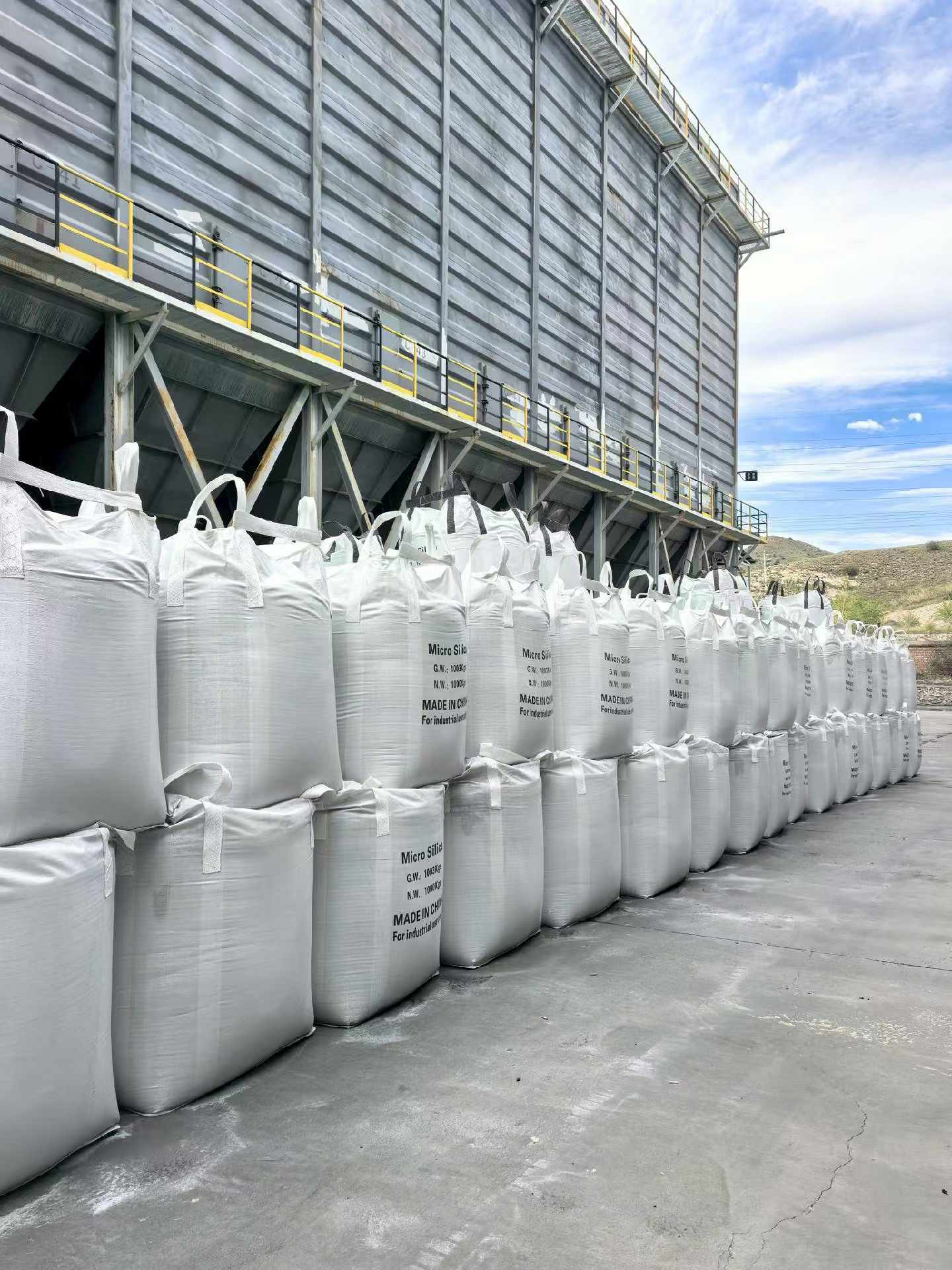
Silica fume plays a dual role in this system: on one hand, its ultra-fine particles (average 0.15μm, about 1/100 of cement) physically fill micro-pores between cement particles; on the other hand, its highly reactive SiO₂ undergoes pozzolanic reaction with Ca(OH)₂ from cement hydration, generating additional C-S-H gel that further strengthens the interfacial transition zone. This is why silica fume is an irreplaceable component in UHPC — no other material can simultaneously provide this physical + chemical dual densification effect.
5 Key Parameters of Mix Design
Based on dense packing theory, UHPC mix design requires precise control of the following 5 parameters. Any parameter deviating from the optimal range will cause significant performance degradation.
Parameter 1: Binder System and Silica Fume Dosage
UHPC binder content is typically 800-1200 kg/m³, 2-3 times that of ordinary concrete. Among these, silica fume dosage is the most critical variable:
| Silica Fume Dosage (% of binder) | 28-day Compressive Strength | Workability | Assessment |
|---|---|---|---|
| 5% | 100-120MPa | Good | Insufficient dosage, inadequate pore filling |
| 8%-12% | 150-180MPa | Medium | Optimal range, strength-workability balance |
| 15%+ | 160-180MPa | Poor | Water demand surges, workability deteriorates |
It is particularly important to note that silica fume quality matters more than dosage. Densified silica fume with SiO₂≥94% performs far better than silica fume with 85%-90% SiO₂. We have encountered multiple cases in actual projects where "15% silica fume was added but strength was only 110MPa" — testing revealed the silica fume had only 82% SiO₂ and 4% carbon content. Such low-quality silica fume not only fails to enhance strength, but also adsorbs superplasticizer and increases water demand.
Parameter 2: Water-Binder Ratio and Superplasticizer System
UHPC water-binder ratio is typically 0.15-0.22, far lower than ordinary concrete (0.40-0.60). At such low W/B ratios, UHPC cannot be placed without high-range water reducers. Superplasticizer selection and dosage is the most technically demanding aspect of mix design:
- Superplasticizer type: Must use polycarboxylate ether (PCE) superplasticizers; naphthalene and melamine-based superplasticizers have insufficient water reduction
- Superplasticizer dosage: Typically 1.5%-3.0% of binder, must be determined by specific material testing
- Retention component: UHPC placement takes time, requiring composite retarding-water retention components to prevent slump loss within 30 minutes
Fiber Orientation: The Overlooked Variable
This is the most underrated technical topic in the UHPC field. With the same mix and same materials, simply changing the casting direction can cause flexural strength to differ by more than 30%. The reason lies in steel fiber orientation.
Steel fibers in UHPC (typically 0.15-0.20mm diameter, 13-20mm length) are not randomly distributed in fresh mix. During casting, mix flow causes fibers to align along the flow direction. For thin-plate elements (such as UHPC facade panels, bridge decks), in-plane fiber orientation can significantly increase flexural capacity; but if fibers orient perpendicular to the loading direction, performance drops dramatically.
Engineering recommendation: For UHPC thin-plate elements, cast along the panel length direction to align fibers with the loading direction. Avoid simultaneous casting from multiple directions, which causes chaotic fiber orientation. For elements thicker than 50mm, the effect of fiber orientation is relatively smaller.
6 Fatal Construction Mistakes
Based on our experience with over 20 UHPC engineering projects, the following 6 mistakes are the most common causes of jobsite strength shortfalls.
- Insufficient mixing time: UHPC has high binder content and ultra-fine silica fume, requiring forced mixing for 5-8 minutes (ordinary concrete only needs 2-3 minutes). Insufficient mixing causes silica fume clumping and uneven fiber dispersion, reducing strength by over 20%
- Wrong charging sequence: Correct sequence is "dry pre-mix 2 min → add water + superplasticizer, mix 3 min → finally add steel fibers, mix 2 min." If steel fibers are added at the beginning, they get broken by aggregate and clump together
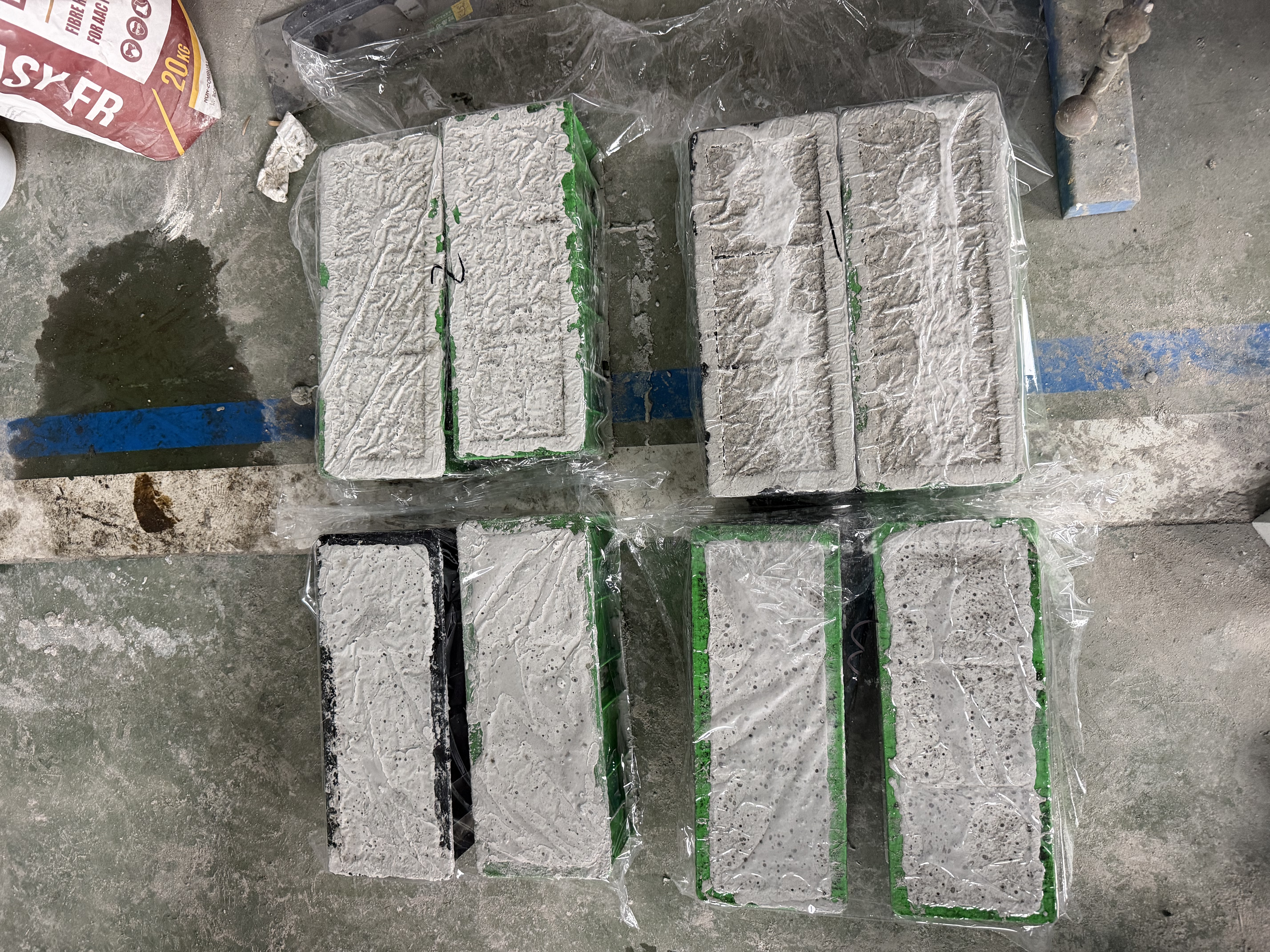
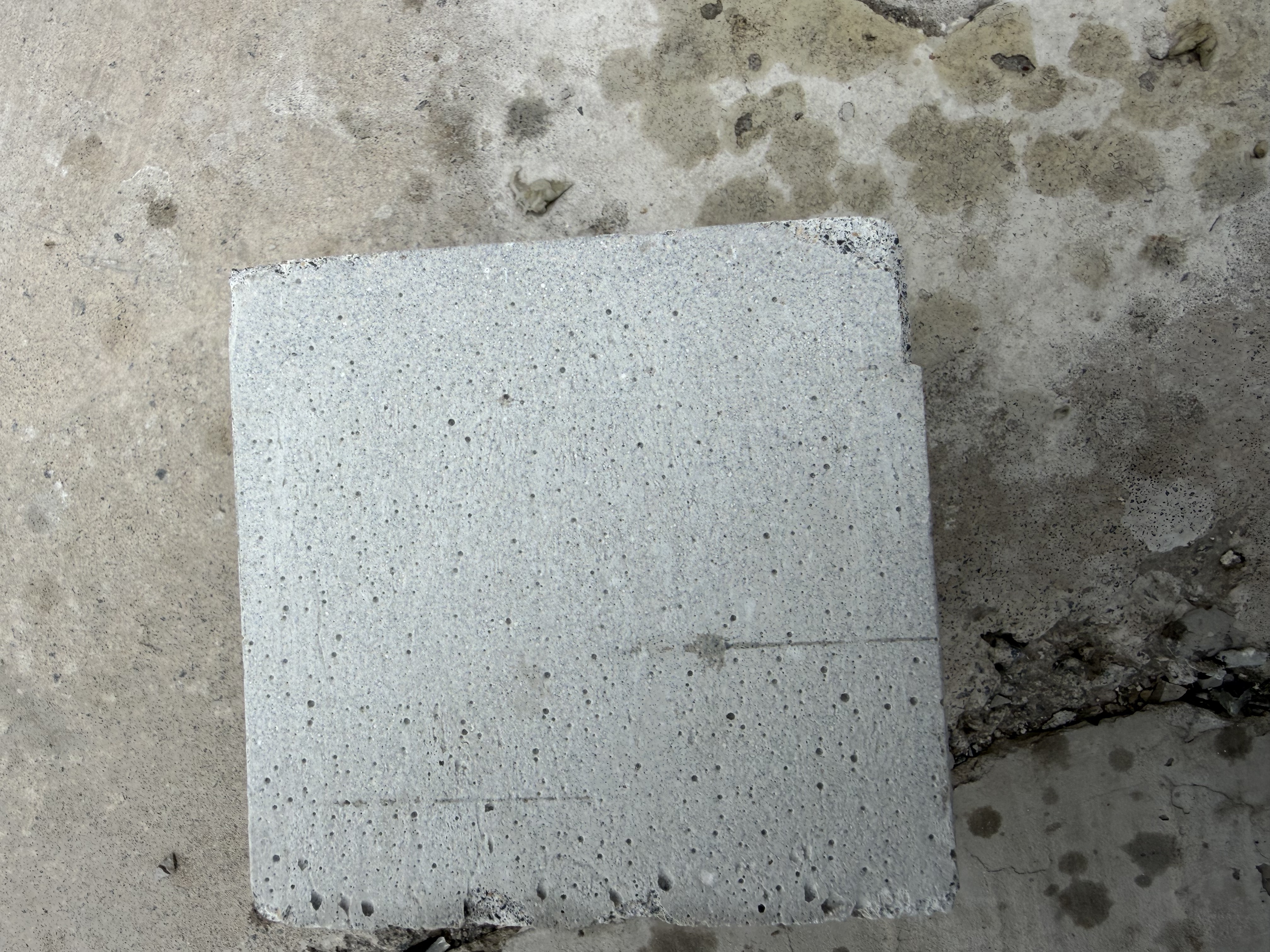
- Improper air entraining agent use: Air entraining agents for ordinary concrete are strictly prohibited in UHPC. The surface voids in Figure 2 are a typical manifestation of excessive air entrainment — these voids not only reduce strength but also become pathways for chloride and water penetration
- Over- or under-vibration: UHPC has good flowability, should use high-frequency low-amplitude vibration (10,000-15,000 rpm, 10-20 seconds). Over-vibration causes steel fiber settlement and segregation; under-vibration leaves excessive air voids
- Excessive casting temperature: UHPC has high binder content and high heat of hydration. In summer construction, if placement temperature exceeds 30°C, it causes false set, rapid workability loss, and even early cracking
- Ignoring autogenous shrinkage: At low W/B ratios, UHPC autogenous shrinkage can reach 500-800 microstrain, 3-5 times that of ordinary concrete. Without proper curing regime and post-casting joints, UHPC elements easily develop early shrinkage cracks
Curing Regime: The Final Gate to Strength
Curing regime affects UHPC strength far more than ordinary concrete. Under different curing methods, 28-day strength can differ by more than 40%:
| Curing Method | Temperature/Duration | 28-day Compressive Strength | Application |
|---|---|---|---|
| Standard curing | 20℃/95%RH | 120-140MPa | Laboratory, low-strength components |
| Steam curing | 90℃/48h | 160-180MPa | Precast elements, bridge decks |
| Hot water curing | 60℃/7d | 150-170MPa | Cast-in-place, large components |
| Natural curing (not recommended) | Ambient temperature | 80-110MPa | Only for non-load-bearing decorative elements |
Steam curing significantly accelerates pozzolanic reaction, allowing silica fume activity to fully develop within 48 hours. For precast UHPC elements, we strongly recommend 90°C steam curing for 48 hours. For large cast-in-place elements, 60°C hot water curing for 7 days, or covering with thermal-moisture membrane + electric heating can be used.
Cost Breakdown: How Much per Cubic Meter?
"UHPC is too expensive" is the feedback we hear most often. But in reality, UHPC costs in many projects are overestimated. Let us break down the true material cost per cubic meter of UHPC (based on China export prices, 2026):
- Cement (1000 kg/m³ × $120/ton): $120
- Silica fume (100 kg/m³ × $400/ton): $40
- Quartz sand (1100 kg/m³ × $50/ton): $55
- Steel fibers (150 kg/m³ × $1,200/ton): $180
- Superplasticizer (25 kg/m³ × $2,000/ton): $50
- Water, others: $15
Total material cost: approximately $460/m³. This price is far lower than the commonly quoted $1,000-$2,000/m³ in the market. The price difference mainly comes from: ① steel fiber dosage (many mixes use 200-250 kg/m³, but 120-150 kg is actually sufficient); ② superplasticizer selection (imported brands cost 3 times more than domestic); ③ precast processing fees and profit.
More important is the life-cycle cost. UHPC durability is 5-10 times that of ordinary concrete. In harsh environments such as bridges and marine engineering, the life-cycle cost of UHPC structures is actually lower than ordinary concrete. Take sea-crossing bridge deck panels as an example: ordinary concrete deck panels have a 50-year design life and require 2-3 major overhauls during that period; UHPC deck panels have a 100+ year design life and are virtually maintenance-free.
Emerging Applications and Future Trends
UHPC applications are expanding from traditional bridges and building facades to more innovative fields:
- 3D-printed UHPC: By adjusting the mix (increasing viscosity, reducing flowability), UHPC can be used for 3D-printed construction, achieving formwork-free fabrication of complex geometries
- Prefabricated construction: UHPC's ultra-high strength allows element cross-sections to be reduced by over 50%, significantly lowering transportation and lifting costs while improving seismic performance
- Wind turbine foundations: Offshore wind turbine foundations face harsh corrosive environments; UHPC's high impermeability and corrosion resistance can significantly extend foundation life
- Military and protection: UHPC impact resistance is over 5 times that of ordinary concrete, with broad applications in blast walls and protective shelters
FAQ
Q1: Can UHPC be mixed on-site, or must it be precast?
Both are possible, but on-site mixing has higher equipment and process requirements. On-site mixing requires a forced-action mixer (5-8 minutes mixing time), with strict control of charging sequence and mixing time. For large projects, we recommend setting up a temporary batching plant on-site; for small projects, pre-bagged UHPC dry mix is more reliable — just add water and mix.
Q2: Must steel fibers be copper-coated? Can stainless steel fibers be used?
Copper-coated steel fibers are the most commonly used type; the copper coating improves fiber-matrix bond. Stainless steel fibers have better corrosion resistance but cost 3-5 times more than copper-coated fibers and have slightly lower matrix bond. For general building and bridge applications, copper-coated steel fibers are completely sufficient; for extreme corrosion environments such as marine engineering, stainless steel fibers or hybrid fibers can be considered.
Q3: How does UHPC early strength develop? Can formwork be removed early?
UHPC early strength develops very quickly. Under standard curing, 24-hour compressive strength can reach 60-80MPa, and 48 hours can exceed 100MPa. Therefore, UHPC elements can typically be stripped 24-48 hours after casting, much faster than ordinary concrete (7-day stripping). But after stripping, curing must begin immediately — elements cannot be exposed to dry environments.
Q4: How to judge if a UHPC mix is qualified? Any quick test methods?
Three quick test methods: ① Flow test — flow table spread should be 200-260mm; too small means insufficient workability, too large may indicate segregation; ② 7-day compressive strength — after steam curing, 7-day strength should reach 130MPa+; ③ Fiber dispersion check — cut open a specimen and inspect the cross-section; fibers should be uniformly distributed without obvious clumping. If all three pass, 28-day strength can basically reach 150MPa+.
Conclusion
UHPC's high strength does not come from some "magic material," but from the synergy of four factors: particle grading, ultra-low W/B ratio, silica fume pozzolanic reaction, and steel fiber toughening. The absence or inadequacy of any one factor will cause significant performance degradation. The gap between lab 180MPa and jobsite 100MPa is essentially a gap in understanding depth of this system.
As a UHPC raw material supplier and technical service provider, our recommendation is: do not blindly pursue "maximum strength," but design the most cost-effective mix based on the specific project's loading characteristics, environmental conditions, and construction capability. A 120MPa mix with stable construction and controllable cost is far more valuable than a 180MPa mix riddled with jobsite problems.
Need UHPC mix design technical support or raw materials?
We provide complete UHPC raw materials including silica fume, steel fibers, superplasticizers, plus custom mix design and on-site technical guidance.
Get Technical Solution View UHPC Products