Table of Contents
A Mix Design Two Thousand Kilometres Away
Last month a precast plant sent me a mix design they had copied from a bridge project two thousand kilometres away, and asked whether they could just run it.
The numbers were fine. The mix was the problem.
Because there is no such thing as "the UHPC mix". There are UHPC mixes, and every one of them is an answer to a specific set of constraints. Change the formwork, the curing chamber, the sand, the fibre, the required age — and the correct mix changes with it.
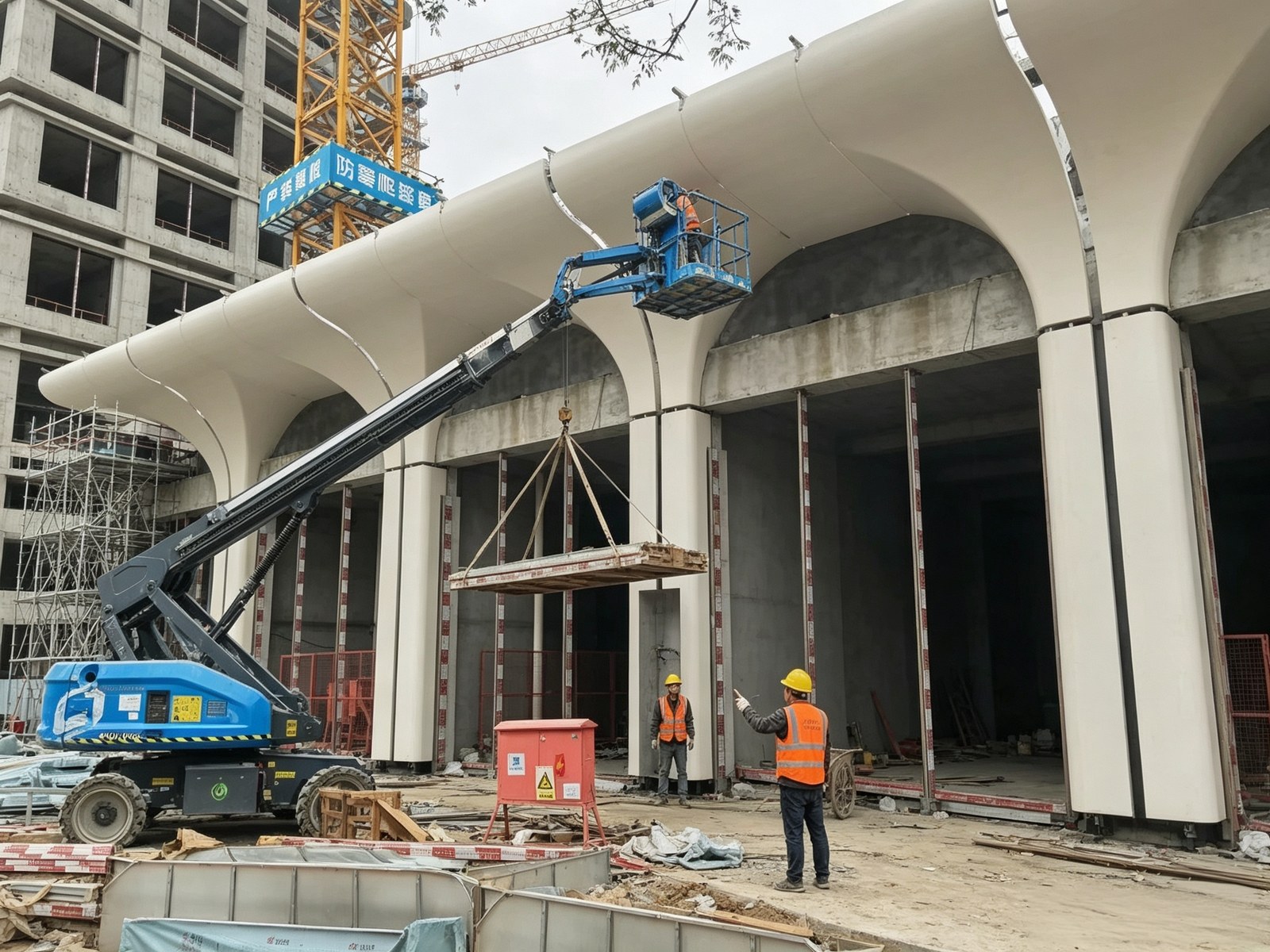
White UHPC facade elements being lifted into position. The colour target, the joint geometry and the absence of on-site steam curing together define the mix — not the strength class alone.
A Spread That Is Not Noise
Here is the part most people miss. Collect the mix designs published over the last fifteen years and normalise everything to cement mass: silica fume lands anywhere between 0.11 and 0.31. Water-to-binder sits between 0.14 and 0.24. Aggregate-to-cement runs from 0.8 to 1.5. Fibre from zero to 2 percent by volume. All of these are published as UHPC. All of them work — in the place they were designed for.
That spread is not noise. It is the fingerprint of different constraints.
Read the spread as a map of constraints, not as a menu of recipes. Every ratio inside that range exists because something in the project demanded it.
Four Projects, Four Different Answers
A Field-Cast Bridge Connection
You are pouring into a joint maybe 150 mm wide, packed with spliced bars, and you cannot vibrate it. Nobody is steam-curing it at the site. The contractor wants to load it in two days.
The FHWA's non-proprietary programme settled on w/c of 0.21 to 0.24, silica fume at 10 percent or more of cement mass, aggregate-to-cement around 1.5, and 1.5 to 2 percent steel fibre by volume, targeting 150 MPa in compression and 5 MPa sustained tensile after cracking. Notice what is doing the work here: not strength, but flow and early gain. The mix has to be nearly self-levelling and still hold fibre without segregation.
An Architectural Precast Panel
Same 150 MPa target, completely different solution. The governing constraint is colour. And there is a hard physical fact underneath it: even 5 to 8 percent grey silica fume replacement is enough, in practice, to visibly grey a white cement mix. You cannot pigment your way out of that. So the entire binder system changes — white cement, white zirconia silica fume, and often fly ash or limestone powder to keep the paste light and the heat of hydration down.
One documented white-cement matrix from the FHWA work runs roughly 778 kg cement, 195 kg silica fume, 189 kg fly ash and 1,167 kg fine sand per cubic metre at w/c 0.23. That is 25 percent fume on cement — nearly double the grey-mix floor — because the white fume has to carry both the colour duty and the packing duty.
A Precast Yard With a Steam Chamber
You have a steam chamber, local sand, and a cost target. Steam curing buys early strength that the mix no longer has to deliver through cement content, so binder comes down, fly ash goes in, and the cubic metre gets cheaper while still clearing 150 MPa at 28 days. One published segmental-beam mix uses 847 kg cement per cubic metre with 2 percent fibre at 12 mm length and 0.16 mm diameter.
Sprayed UHPC for Repair
This is where the logic inverts. In a cast mix you want low yield stress so it flows. In a sprayed mix you want yield stress to climb fast so it sticks to a vertical face and does not sag. Fresh material sits at tens of pascals and has to recover to several hundred within minutes, or you cannot build more than a thin pass. Same material family, opposite rheology, different admixture architecture.
Four projects, one material family, four incompatible rheologies. Copying a bridge-connection mix into a spray rig is not a shortcut — it is a rework order.
Four Dials, Not Four Ingredients
If you want to design rather than copy, think in four dials.
Water-to-Binder Sets Porosity
Below about 0.20 you are fighting for workability. Above 0.24 you are giving away strength and durability you already paid for.
Silica Fume Sets Packing and the Pozzolanic Ceiling
This is the dial most often set by habit. The early reactive powder concretes ran 25 to 30 percent because they had no better way to fill the gap. Modern mixes with proper polycarboxylate dispersants and graded fillers do the same job at 8 to 12 percent. More fume is not more strength. Past a point it is more water demand, more shrinkage, and a bigger bill.
Packing Decides How Much Water You Need in the First Place
This is the least intuitive one. In the FHWA trials, mixes with coarse aggregate actually needed less water for the same spread — and still came out weaker than the all-fine mixes at a slightly higher w/c. Because strength here is decided by how particles sit together, not by top size.
Admixture Architecture Sets Rheology
The superplasticiser dose that gives you a beautiful flowing cast mix will give you a segregating mess in a spray mix, or one that cannot be pumped.
Get those four right and the ingredient list almost writes itself. Get them wrong and no amount of "good" silica fume saves you.
Which Fume, and Why It Matters More Than the Datasheet
Grey Silica Fume: The Workhorse
For UHPC the number that actually matters is not only SiO2 above 90 percent. It is carbon. The FHWA work specifically prefers low-carbon fume, under about 0.7 percent, because carbon eats your dispersant budget and shows up as dark specks in a pale mix. After that: BET in the 15 to 27 m²/g band, a sub-micron d50, and chloride under 0.1 percent if you are prestressed or marine. Densified versus undensified is a logistics decision, not a performance one — densified moves cheaper, undensified disperses more easily.
White Zirconia Silica Fume Is a Different Animal
It is not bleached grey fume. It comes from a different furnace — fused zirconia rather than silicon metal — which is why it carries 3 to 5 percent ZrO2 and a whiteness above 85, with around 92 measured in published work. Low iron, low carbon. At ambient curing the ZrO2 fraction is essentially inert; it is not doing pozzolanic work. What it does is optical and thermal: higher refractive index, no grey cast, and real value once service temperature climbs.
But here is the part that belongs in your trial batch, not in a brochure.
Published particle work on zirconia-route fume reports primary spheres of roughly 0.5 to 3 micron, heavily agglomerated, d50 around 2.5 micron — against a sub-micron d50 for typical grey fume. Supplier BET data for the white grades often sits at 6 to 15 m²/g. That is a coarser powder.
So if you swap white fume into a UHPC one-for-one by weight and expect the same 28-day number, you will be disappointed. That is not a defect, it is physics. The fix is ordinary engineering: raise the dosage and test, blend a fine fraction in to rebuild the packing curve, or accept the colour premium where colour is the actual specification and stop pretending it is a strength play.
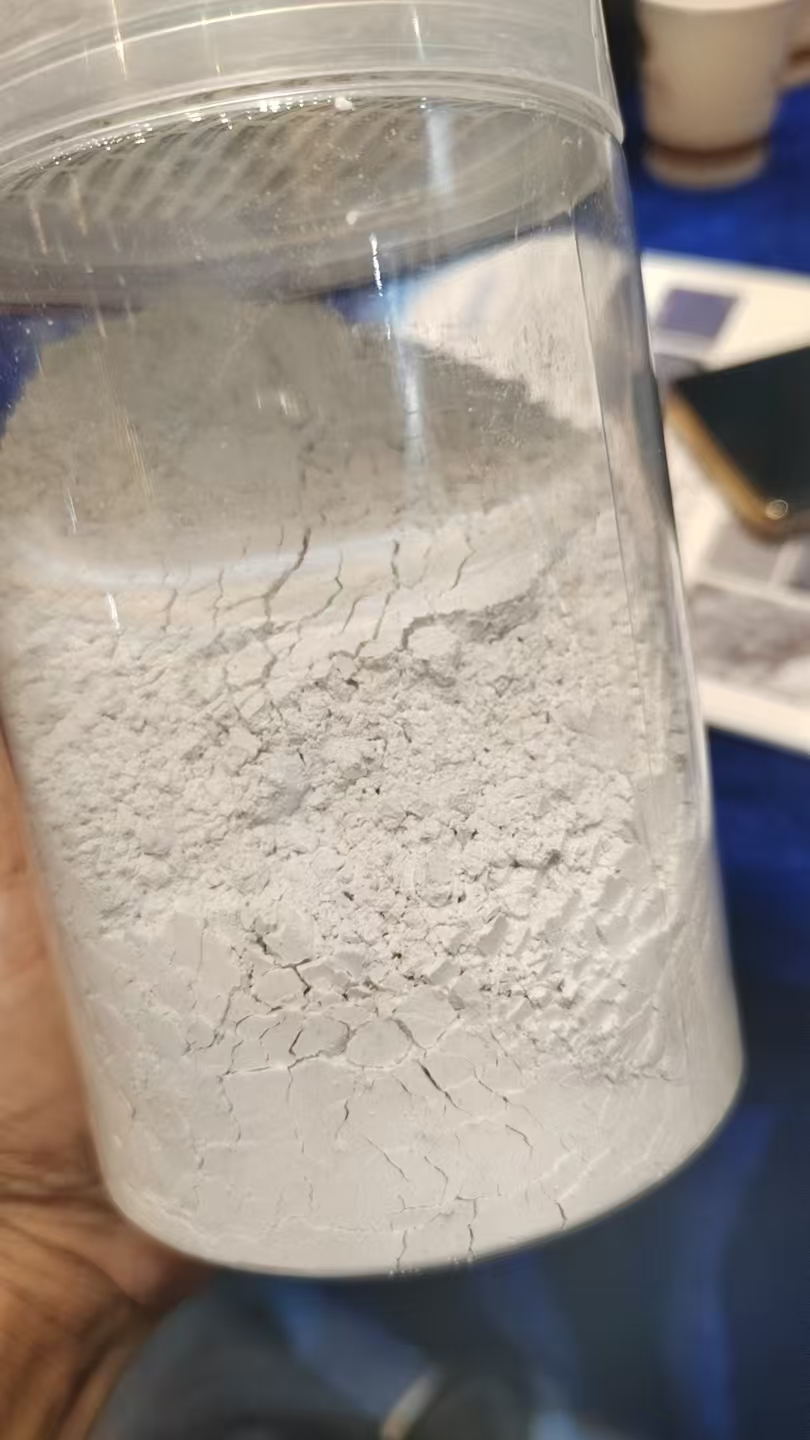
White zirconia silica fume. The whiteness comes from the feedstock and furnace route, not from bleaching — and the same route that removes the grey cast also sets the particle size distribution.
The Mix Is a Hypothesis
Every mix design on paper is a hypothesis. The trial batch is the experiment, and the only honest result is the one you measured with your sand, your water temperature, your mixer and your curing regime.
Copy the ratio and you inherit someone else's constraints. Copy the logic and you can solve your own.
What is the strangest constraint you have had to design a UHPC around? Mine involved a 40-degree site, a 90-minute transport window, and a client who insisted on white.
Send Us Your Constraints, Not Just a Number
Tell us the joint width, the curing regime, the colour target and the 28-day requirement. We will come back with a starting mix and a trial-batch plan — not a copied datasheet.
Request a Mix Consultation View White Silica Fume