Table of Contents
- SiO₂ is the entry ticket, not the performance guarantee
- The three numbers that actually move performance
- The pile in the photo: agglomeration, densification, dispersion
- Match the grade to the application, not the highest number
- Datasheet checklist you can copy into your next RFQ
- Read the carbon first, the price second
SiO₂ Is the Entry Ticket, Not the Performance Guarantee
Last quarter a precast buyer sent three silica fume quotations side by side. In some markets this powder is also called microsilica or micro silica, but it is the same material — condensed silica fume recovered from silicon metal and ferrosilicon furnaces. One quoted 92% SiO₂, another 95%, another 98%. Prices differed by nearly a factor of two, and the instinct was simple: take the middle 95%, which looks like the safe compromise.
That instinct is where most silica fume buying decisions go wrong. The SiO₂ ratio is the entry ticket to the comparison: it tells you the powder is mainly reactive silica, but it does not tell you whether it will drag extra water into the mix, consume your superplasticizer dose, grey out a white panel, or reach the 28-day strength your specification calls for. Two fumes on the same SiO₂ can behave like two different materials in the mixer.
Start with the number everyone reads first. SiO₂ content measures what share of the powder is reactive silicon dioxide. A good fume usually bottoms out around 85%; high-reactivity grades sit above 92%, and high-purity white grades reach 98% or more. Below that threshold the rest of the datasheet matters less — you are buying filler. Once you are past the threshold, lifting SiO₂ another three or four points does not raise concrete strength in a straight line. The remaining gap is occupied by things the SiO₂ line does not show.
Loss on Ignition (LOI) and Free Carbon
LOI measures what burns off when the sample is heated; in silica fume that fraction is mostly unburned carbon from the silicon metal furnace. Carbon is a problem in concrete for two reasons. First, it adsorbs superplasticizer molecules: a high-carbon fume quietly spends part of your dispersant budget, so the same admixture dose leaves a stiffer mix, or you end up pumping in more plasticizer than your cost model assumed. Second, fine dark carbon particles show up as mottling in pale or white concrete, which no amount of white cement or pigment corrects afterwards.
Alkalis and Other Impurities
Traces of Na₂O and K₂O can take part in alkali-silica reaction in sensitive mixes; Fe₂O₃ is the main driver of dark tone in an otherwise light fume. For decorative concrete, white UHPC and GRC, the impurity profile matters as much as the SiO₂ that heads the sheet.
Moisture Content
Silica fume is hygroscopic. A powder that arrived at 0.8% moisture and sat two months in a damp container can arrive with higher moisture — and every extra 1% free water shifts your effective water-to-binder ratio before you start the mixer. Specify moisture on the datasheet and check it on receipt, not only at the factory gate.
Our own grades reflect this division: the high-purity white fume carries LOI ≤2.0% and moisture ≤1.0%; the black and economy grey grades sit at LOI ≤3.0%, which matches their usual job — structural concrete, where colour and extra dispersant demand weigh less than cost per cubic metre.
The Three Numbers That Actually Move Concrete Performance
If SiO₂ is the ticket, the next three are what decide whether the mix works.
BET Specific Surface Area
It is the total area per gram of powder, in m²/g. Silica fume works partly as a micro-filler: submicron spheres slot between cement grains and refine the pore structure, which cuts water absorption and chloride penetration; and partly as a pozzolan, where the high area is the surface on which the pozzolanic reaction with calcium hydroxide takes place. Quality fumes sit in the 15–25 m²/g band. Too low, and the filling and reacting duties are weak; too high, and you bought a powder that demands more water than you budgeted for.
Particle Size Distribution and d50
BET gives the area; d50 and the distribution tell you whether that surface is reachable. Freshly captured fume consists of submicron spheres, but those spheres agglomerate as they cool and are collected. A coarse d50 with large, hard clumps means part of the advertised area never releases in a short mixing cycle — paper numbers and real in-mix values diverge. That is why commercial datasheets carry a 45 μm sieve residue line: it flags oversized clusters that should not go into a demanding mix.
Water Demand and 28-Day Activity Index
Two derived numbers tell the real story after mixing. Water demand compares the water needed to reach a fixed flow; the activity index compares mortar strength against a control mix at 7 and 28 days. A high BET that also pushes up water demand is a trade-off, not a free bonus. The 28-day activity index is the closest thing on paper to a long-term strength gain promise.
These three — area, reachable particle size, and the resulting strength index — are the columns a technologist reads before the price column.
The Pile in the Photo: Agglomeration, Densification, Dispersion
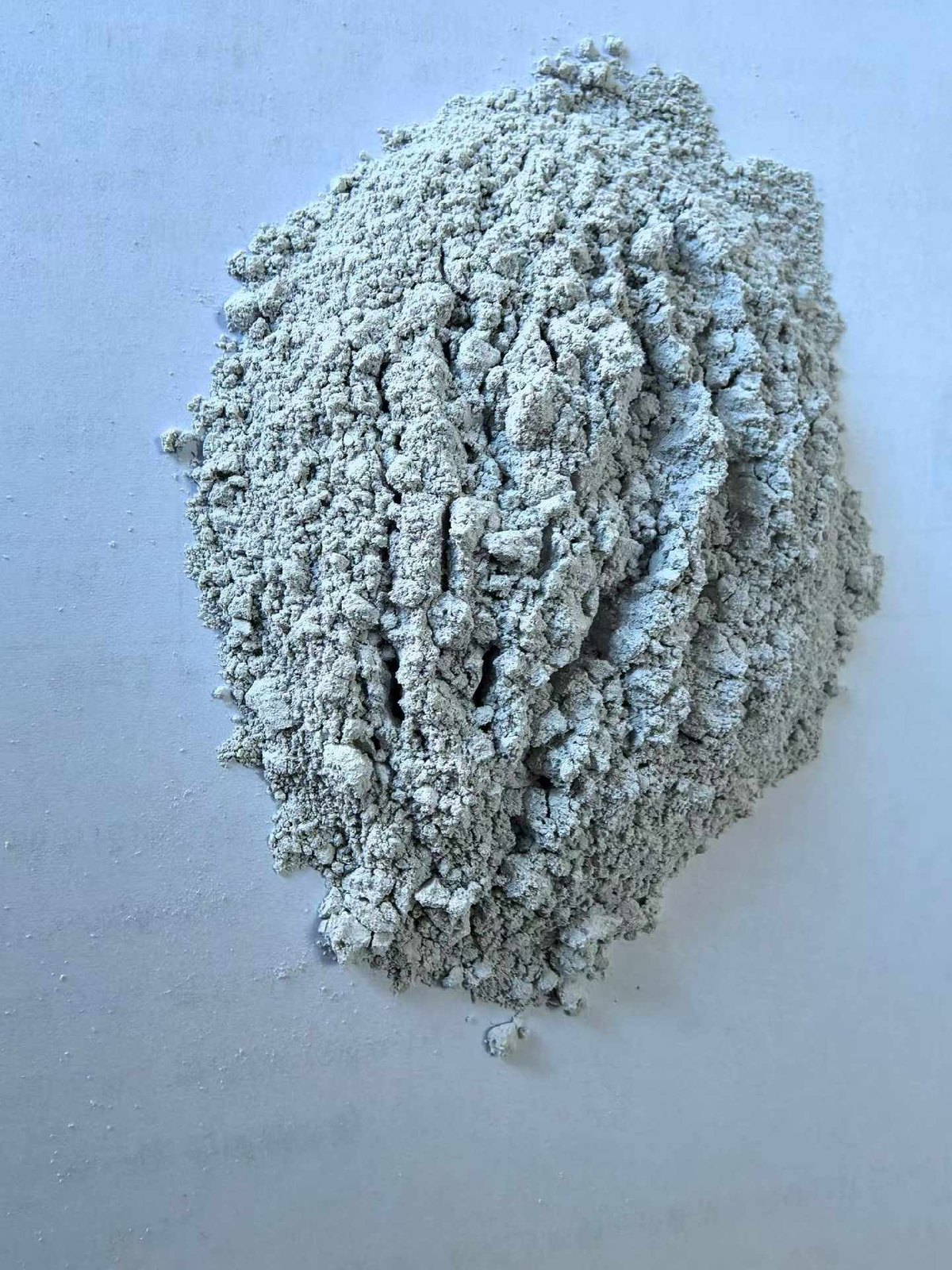
A pile of grey silica fume. The loose fines and the small cracked lumps are the same powder in two physical states; whether the lumps break apart during mixing decides how much surface your concrete actually gets.
Look at the pile above. The dusty fines and the small cracked lumps sitting together are the same powder in two physical states. Those lumps are agglomerates — clusters of microspheres bound by van der Waals forces and collection conditions, not by sintering. Whether they break up during mixing decides what share of the advertised surface your concrete actually receives.
- Undensified (crude captured) fume has the lowest bulk density and the most dust. It disperses more easily in water because its clusters are looser, but it handles badly in transport and storage: lower bulk density means fewer tonnes per container and stricter on-site dust control.
- Densified fume is compacted into granules to raise bulk density and cut shipping cost. It pours, bags and loads far better, but the granules need a proper mixing cycle to break back down; in a short, low-shear mixer some may survive as small nuclei.
- Micronized / ground fume has its agglomerates deliberately milled apart, paying an extra processing cost for a finer, more uniform powder; worth considering in high-performance and precast applications where consistent flow matters.
Practical point: physical form is a logistics and dispersion decision, not a chemistry decision. Densified or not does not change the SiO₂, but it changes how that SiO₂ reaches the paste. Ask the supplier what form they ship in, what bulk density to plan on for loading, and whether the activity index was measured after dispersing the clusters properly.
Match the Grade to the Application, Not the Highest Number
The highest percentage on a datasheet is rarely the right answer for every application. Over-specifying wastes money; under-specifying forces the mix to compensate somewhere else.
General High-Strength and Structural Concrete (C40–C70, Grout, Shotcrete, Foundations)
A grey or black grade around 92% is the usual cost-effective choice. Colour does not matter, structural performance does; these grades gain compressive strength through pozzolanic reaction and pore refinement, at a lower cost per tonne.
High-Strength and Marine Structures (C60–C80, Bridge Decks, Durable Precast)
A 90–95% grey grade with a solid 28-day activity index and controlled moisture is the safer pick: here chloride penetration resistance and lot-to-lot strength consistency weigh more than a small price difference.
UHPC and High-Performance Matrices
Fume dosage climbs here, typically 15–25% of binder, because the matrix relies on dense packing and very low permeability. Low-carbon fume is preferred in pale or white matrices, and the high-purity white grade is mandatory wherever the finished face has to stay white: grey fume, even at moderate replacement, visibly greys a white cement matrix.
Refractory Castables
The job is different. Here a zirconia-bearing white grade delivers ZrO₂ phase-transformation reinforcement and mullitization at high temperature, with a recommended dose around 4–8% of castable weight. It is chosen for thermal shock and slag resistance, not for concrete compressive strength.
Decorative Concrete, White Panels, GRC
Whiteness, low iron and low carbon are the specification, not maximum SiO₂. This is the category where picking a cheaper grey fume to save on powder usually costs more later in rework and rejected panels.
The dose in conventional concrete is 5–10% of cementitious material, on an equivalent cement replacement; the exact value is set by trial batch, and curing matters as much as the powder: silica fume concrete is more sensitive to early wet curing, and inadequate curing is a frequent cause of strength below the datasheet promise.
Datasheet Checklist You Can Copy into Your Next RFQ
Before comparing quotes, ask every supplier for the same six numbers, measured to the same reference standard (ASTM C1240 is the common reference):
- SiO₂ content — confirm the floor for your strength class; treat higher grades as a premium only where the application needs it. (Microsilica under another trade name usually carries the same lines.)
- Loss on ignition / free carbon — lower for pale mixes, superplasticizer-sensitive mixes, and any finish where mottling matters.
- BET surface area — check the band against your mix design; read area together with water demand rather than alone.
- Particle size / d50 and 45 μm sieve residue — flag coarse, hard agglomerates that may not disperse in your mixer.
- Activity index (7d / 28d) — the evidence of strength; ask for the test method and control mix, not just a rounded number.
- Moisture content — needed at lot release and re-checkable on receipt; feed it into your water-to-binder calculation.
Beyond the sheet: request a third-party or SGS-style report on the lot, keep a dispute sample, and run a small trial batch with your own cement, sand, water temperature and admixture before committing a container load. The datasheet describes a material; the trial batch describes how it behaves in your real mix.
Read the Carbon First, the Price Second
Silica fume looks like a commodity when you compare a single line of the offer: price per tonne, SiO₂ percentage. It behaves like an engineering material once it reaches the mixer, and the numbers that decide that are often not the one a buyer looks at first.
Read the carbon, the area, the reachable particle size and the activity index first; match the grade and physical form to the job; then let a trial batch confirm what the datasheet promised.
The highest SiO₂ on the sheet is rarely the best-performing fume in your mixer. It becomes the right choice only when every other line on the datasheet matches your application.
Compare Grades Against Your Mix
Tell us your concrete class, exposure environment, colour target and 28-day requirement. We will suggest the grade, physical form and dosage range, and supply a 1–2 kg sample for trial.
Request Grade Recommendation View Silica Fume Products