How One Bag of White Powder Solves the Top Pain Points of Concrete Producers, UHPC Manufacturers and Refractory Companies
From 3 AM complaints at the batching plant, to 180MPa on the UHPC QC bench, to 50 thermal shock cycles in the refractory workshop — one material, three industries, one answer.
Table of Contents
- Scene 1: 3 AM at the Concrete Batching Plant
- Scene 2: The QC Bench at the UHPC Precast Factory
- Scene 3: Thermal Shock Testing at the Refractory Workshop
- The Answer: White Zircon Silica Fume — One Material, Three Industries
- Core Technology: Why It Works Across Industries
- Optimal Dosage and Practical Tips for All Three Industries
- The Cost Truth: Is $200/ton More Really Worth It?
- FAQ
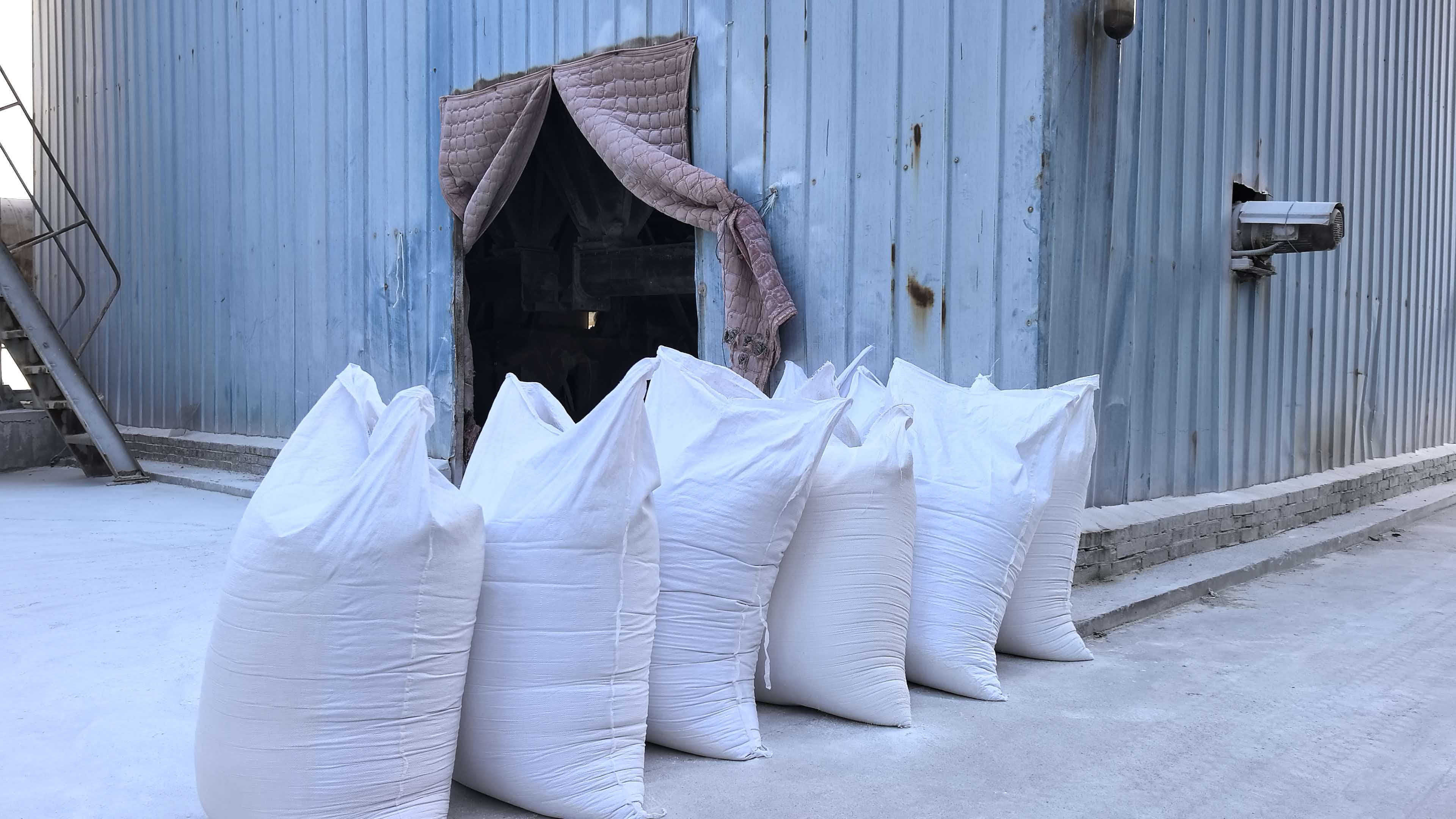
Fig.1: Finished white zircon silica fume in standard 25kg bags, neatly arranged outside the factory before shipment. This powder is heading to three completely different industries.
If you own a concrete batching plant, you have definitely experienced this kind of early morning: a client calls, complaining that today's concrete is darker and grayer than the last batch, demanding a return. If you are the technical director of a UHPC precast factory, you have certainly stood at the QC bench torn apart: strength reached 180MPa, but the appearance is yellowish-gray, and high-end curtain wall clients reject it. If you manage a refractory plant, you have certainly paced in front of the thermal shock tester: same formula, some batches survive 50 cycles, some crack at 20, and clients keep complaining.
Three industries, three completely different products, three seemingly unrelated pain points. But over the past three years, more and more concrete producers, UHPC manufacturers and refractory companies have found the answer in the same material — white zircon silica fume.
This is not marketing talk. This article is not about parameter tables or vague concepts. We walk into three real factory scenarios to see what actual problems white zircon silica fume solves, and why it has been accepted by three vastly different industries simultaneously.
Scene 1: 3 AM at the Concrete Batching Plant — "Why Is Today's Concrete So Dark Again?"
Houston, Texas, USA — a ready-mix concrete plant producing 300,000 cubic yards per year. At 3 AM, the phone rings in the dispatch office. It is a long-time client working on a high-end residential project, and he is furious: "The C40 concrete you delivered today is gray and dark, completely different from last week's batch. The inspector has stopped work. Get over here now."
The plant manager arrives and sees the problem immediately: today's batch is noticeably darker, and when placed next to last week's light-gray concrete, the color difference is obvious. The cause is quickly found — today they switched to a batch of gray silica fume with higher carbon content, which darkened the entire concrete.
This is not the first time. Gray silica fume has wildly fluctuating carbon content, from 2% to 8%, and every batch looks different. For plants doing ordinary municipal projects, darker or lighter color does not matter — as long as the strength is right. But clients doing high-end residential, commercial complexes, and fair-faced concrete have extremely strict color consistency requirements — every column in the same building must be identical.
The core pain point: Gray silica fume has unstable carbon content (2%-8%), causing color variation in every batch. High-end clients have zero tolerance for color difference — one complaint can cost you a long-term project.
This plant later ran a simple test: replace gray silica fume with white zircon silica fume, keeping everything else exactly the same. The results were surprising — not only did the concrete color become a stable light gray-white with virtually no batch-to-batch variation, but 7-day compressive strength also increased by 8%-12%. The reason is simple: white zircon silica fume has SiO2 ≥94%, carbon ≤0.5%, Fe2O3 ≤0.5% — purity far above gray silica fume. Higher reactivity, more stable color.
Now this plant uses white zircon silica fume across its entire high-end product line. Although the raw material costs over $200 more per ton, high-end projects command 15%-20% higher prices than ordinary concrete, and there have been zero color-related complaints. The plant manager says: "I used to dread 3 AM phone calls. Now I can finally sleep through the night."
Scene 2: The QC Bench at the UHPC Precast Factory — Can 180MPa and Pure White Appearance Coexist?
Munich, Germany — a factory producing UHPC (Ultra-High Performance Concrete) precast elements, mainly curtain wall panels, landscape benches and decorative moldings. Their clients are Europe's top architectural institutes and real estate developers, and their requirement for the product can be summed up in one word — perfection.
The technical director picks up two UHPC test blocks at the QC bench. One is made with gray silica fume — strength reached 185MPa, fully meeting design requirements, but the appearance is yellowish-gray with subtle color spots on the surface. The other is made with white zircon silica fume — strength 180MPa, slightly lower, but the appearance is pure milky white, smooth as porcelain, with zero color variation.
The client chose the second one.
"For UHPC curtain walls, strength is just the entry ticket. Appearance is what wins or loses the job," the technical director says. "Design institutes want pure white, uniform, delicate surface finish. Products made with gray silica fume have patchy color — they never pass the design institute's aesthetic standards."
The core pain point: High-end UHPC applications (curtain walls, decorative elements) require both pure white appearance and ultra-high strength. Gray silica fume has the strength but poor color; ordinary white silica fume has the color but insufficient reactivity and cannot reach high strength.
The trickier issue is flowability. UHPC has an extremely low water-binder ratio (typically 0.16-0.20). Achieving self-compacting flow at such a low water-binder ratio demands exceptional particle grading and sphericity from silica fume. Ordinary white silica fume may have good color, but its irregular particle shape and high water demand make it impossible to flow in an ultra-low water-binder UHPC system.
White zircon silica fume resolves this contradiction. With an average particle size of 0.1-0.3μm, specific surface area of 15,000-25,000 m²/kg, high particle sphericity, and water demand even lower than gray silica fume. In UHPC formulations, replacing gray silica fume with white zircon silica fume results in:
- Appearance: from gray-yellow to pure milky white, color difference ΔE ≤ 1.5
- Strength: 28-day compressive strength stable at 170-190MPa
- Flowability: spread increases from 620mm to 680mm, better self-compacting
- Surface quality: finer and smoother, fewer air bubbles, no polishing needed after demolding
This factory now uses white zircon silica fume for 100% of its UHPC curtain wall product line. Although raw material costs increased, product unit prices rose by 30%, and thanks to stable appearance quality, the rework rate dropped from 15% to below 2%.
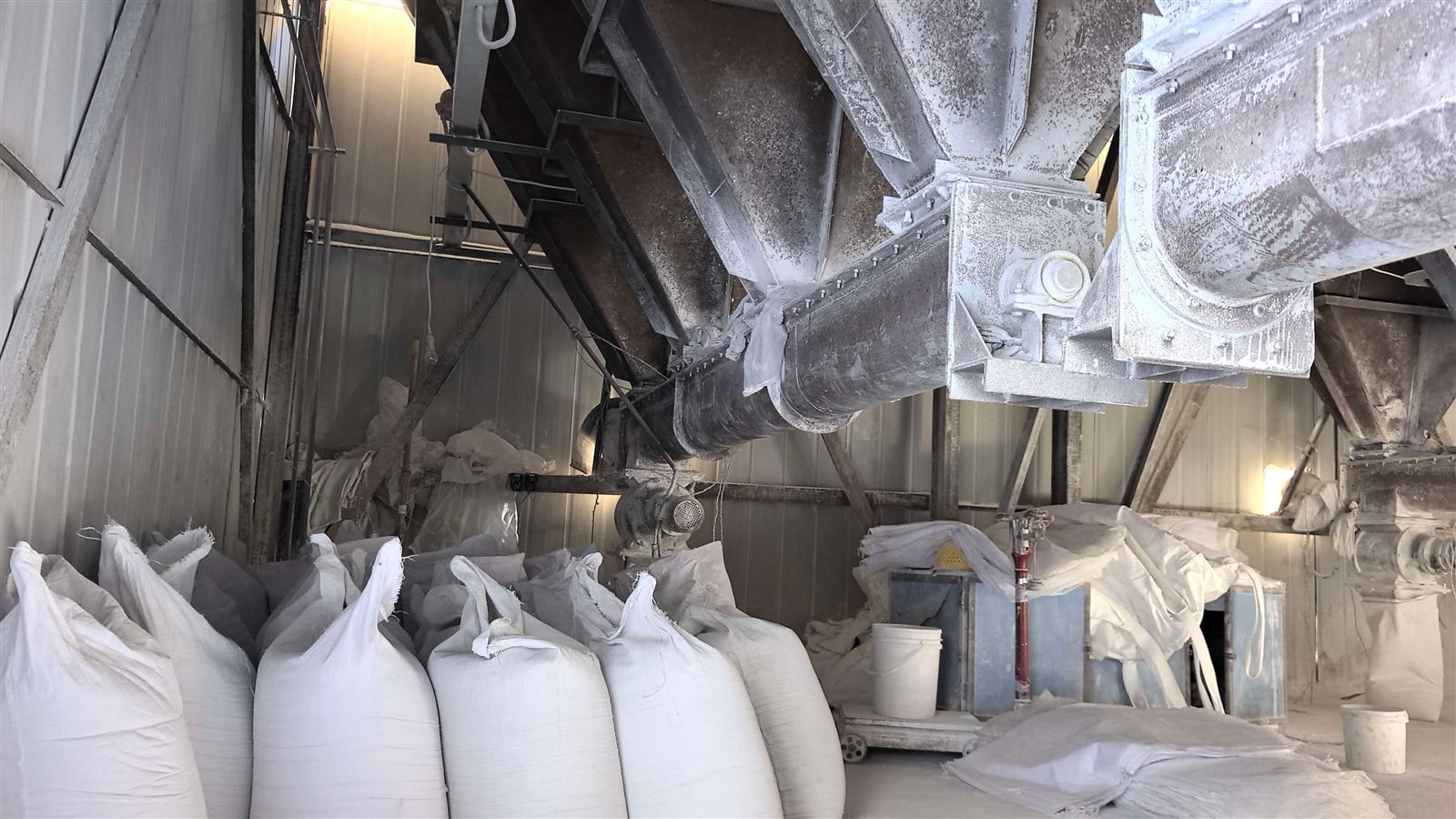
Fig.2: Inside the production workshop. Sealed conveyor pipes and silos above, finished 25kg bags below. The entire process runs in a closed system to ensure product purity and color consistency.
Scene 3: Thermal Shock Testing at the Refractory Workshop — The 50-Cycle Lifeline
Pohang, South Korea — a refractory plant producing ladle castables and tundish coatings for the local steel giant. The plant manager stands in front of the thermal shock tester, frowning at the freshly removed specimen. This specimen is a ladle castable made with traditional gray silica fume, and in the 1100°C water-cooling thermal shock test, visible cracks appeared at the 18th cycle.
"The client requires 50 cycles without cracking. Our best batch only reaches 25," the plant manager says. "Ladle liners operate above 1500°C under molten steel erosion, and every tap is a violent thermal shock. Poor thermal shock stability means short ladle life, and clients have to stop frequently for repairs — very costly."
The core pain point: Refractory castables made with traditional gray silica fume only achieve 15-25 thermal shock cycles. Ladles, tundishes and other high-temperature equipment require 50+ cycles — a huge gap. Additionally, the carbon content in gray silica fume causes structural spalling at high temperatures.
Thermal shock stability in refractories is essentially the material's ability to resist cracking under rapid temperature changes. Traditional solutions involve adding fibers or reducing elastic modulus, with limited effect. White zircon silica fume solves this from a completely different angle — ZrO2 phase transformation toughening.
White zircon silica fume contains 2%-3% ZrO2 (derived from natural zircon in the quartz raw material). These ZrO2 particles undergo a martensitic transformation from tetragonal to monoclinic at around 1170°C, accompanied by 3%-5% volume expansion. This expansion has two key effects:
- Compensating sintering shrinkage: Refractories shrink and develop microcracks during high-temperature sintering. The ZrO2 phase transformation expansion precisely compensates this shrinkage, maintaining dimensional stability.
- Crack deflection toughening: When thermal shock cracks propagate to ZrO2 particles, stress-induced phase transformation expansion creates compressive stress at the crack tip, "pinning" the crack and preventing further propagation.
Measured data: In the same ladle castable formula, replacing gray silica fume with white zircon silica fume (6% addition) increased 1100°C water-cooling thermal shock cycles from 18 to 52 — nearly a 3x improvement. Meanwhile, because white zircon silica fume has carbon ≤0.5% (vs. 2%-8% in gray silica fume), structural spalling from carbon oxidation at high temperatures is eliminated.
This refractory plant now uses white zircon silica fume for all its ladle castables and tundish coatings. Average ladle life increased from 45 heats to 78 heats, and clients' furnace stoppage for repairs decreased by 40%. The plant manager says: "Clients used to complain about short life. Now it's the opposite — they ask if we can push life even higher."
The Answer: White Zircon Silica Fume — One Material, Three Industries' Common Choice
Three industries, three completely different products, three seemingly unrelated pain points. Yet white zircon silica fume solves all of them. This is no coincidence — it is because the core properties of white zircon silica fume — high purity, high reactivity, ZrO2 phase transformation toughening — precisely hit the common needs of all three industries:
Core Technology: Why It Works Across Industries
White zircon silica fume is not "whiter gray silica fume" — it has fundamental differences at the mineralogical and materials science level. Understanding the three core mechanisms below explains why it is accepted by all three industries simultaneously.
Mechanism 1: Microfiller Packing and Densification — The Foundation for All Industries
Whether in concrete, UHPC or refractory castables, the particle grading of the binder matrix shares a common deficiency: cement/aluminate cement particles are 0.075-0.1mm, aggregates are above 1mm, and the 0.1μm-10μm range is full of voids. White zircon silica fume, with an average particle size of 0.1-0.3μm, precisely fills this range, reducing matrix porosity from 18%-22% to 10%-14%.
What does lower porosity mean? For concrete: higher strength, lower permeability, better durability. For UHPC: denser matrix, higher strength. For refractories: fewer slag penetration channels, longer life. Three industries, one physical mechanism.
Mechanism 2: Pozzolanic Reactivity — Strength Gain from Chemical Reaction
White zircon silica fume has SiO2 ≥94%, and it is amorphous non-crystalline SiO2 with extremely high chemical reactivity. In concrete and UHPC, it reacts with Ca(OH)2 from cement hydration to form C-S-H gel, further filling pores and increasing strength. In refractories, it reacts with Al2O3 at 1000°C-1400°C to form mullite (3Al2O3·2SiO2) — one of the most ideal mineral phases in refractories, with a melting point of 1850°C and excellent creep resistance.
Mechanism 3: ZrO2 Phase Transformation Toughening — The Refractory Industry's Exclusive Weapon
This is the core advantage that distinguishes white zircon silica fume from all other silica fume products. Gray silica fume contains no ZrO2, and neither does ordinary white silica fume. Only white zircon silica fume — because its raw material contains naturally associated zircon (ZrSiO4) — decomposes during production into 2%-3% ZrO2 particles, uniformly distributed in the SiO2 matrix.
The high-temperature phase transformation toughening effect of these ZrO2 particles improves refractory thermal shock stability by nearly 3x. This is something gray silica fume and ordinary white silica fume can never achieve.
Optimal Dosage and Practical Tips for All Three Industries
Based on our practical application experience at over 20 factories across all three industries, here are the verified optimal dosages and practical considerations:
| Industry / Application | Dosage (% of binder) | Key Considerations |
|---|---|---|
| Ready-Mix Concrete (C40-C60) | 5%-8% | Replace part of fly ash or slag, adjust superplasticizer +0.2% |
| UHPC (150-200MPa) | 15%-25% | Equal replacement of silica fume, control total powder volume, w/b 0.16-0.20 |
| Ladle Castable | 5%-8% | Replace part of alumina micro-powder, water +1%-1.5%, heating ≤30°C/h at 1000-1200°C |
| Tundish Coating | 8%-12% | Promotes mid-temperature sintering, forms dense working face, reduces slag penetration |
| Fair-Faced / Decorative Concrete | 6%-10% | Ensure color consistency — same project must use same batch |
A practical reminder common to all three industries: white zircon silica fume is finer and has larger specific surface area than gray silica fume, making it more hygroscopic. Store sealed and moisture-proof, use promptly after opening. If slight caking occurs, it is not a quality issue — simply pass through an 80-mesh sieve before use.
The Cost Truth: Is $200/ton More Really Worth It?
White zircon silica fume is indeed more expensive than gray silica fume — by about $200-400/ton. Many clients' first reaction is "too expensive." But if you only look at raw material unit price, you miss the true cost structure.
Let us do the math for all three:
Concrete producer's math: High-end concrete projects command 15%-20% higher prices than ordinary concrete. Using white zircon silica fume increases raw material cost by about $2-3 per cubic meter, but the selling price increases by $10-15/m³. More importantly, it eliminates return losses and client churn from color complaints. A batching plant losing one client purchasing 50,000 m³/year due to color issues loses far more than the raw material price difference.
The UHPC manufacturer's calculation: UHPC curtain wall elements are priced at $300-700 per square meter, and appearance quality directly determines whether they pass the architectural institute's acceptance. After using white zircon silica fume, raw material costs increase by about $8-12 per square meter, but the product acceptance rate rises from 85% to 98%, significantly reducing rework costs. More critically, the pure-white appearance opens up the high-end curtain wall market, raising unit prices by more than 30%.
Refractory producer's math: Ladle castables sell for $800-1500/ton, and ladle life is the client's top concern. Using white zircon silica fume increases raw material cost by about $15-25 per ton of castable, but ladle life rises from 45 heats to 78 heats, reducing the client's refractory cost per ton of steel by 25%. Refractory plants can leverage the life advantage to raise product prices by 10%-15%, actually increasing profits.
Conclusion: Don't just look at raw material unit price. Factor in product qualification rate, client churn cost, life improvement, and pricing headroom — white zircon silica fume is a material that "gets cheaper the more you use it" in all three industries.
FAQ
Q1: What is the difference between white zircon silica fume and ordinary white silica fume?
Ordinary white silica fume contains only SiO2, no ZrO2. White zircon silica fume contains 2%-3% ZrO2 (from natural zircon in the raw material), which is the key to its phase transformation toughening in refractories. In concrete and UHPC, both have similar color effects, but white zircon silica fume has higher reactivity and lower water demand.
Q2: Can white zircon silica fume directly replace gray silica fume at equal dosage?
Yes, equal replacement is possible, but you need to fine-tune water and superplasticizer dosage. White zircon silica fume has a larger specific surface area, and its water demand is about 10%-15% higher than gray silica fume. We recommend running lab compatibility tests first to determine optimal water content before batch production.
Q3: Is higher ZrO2 content in white zircon silica fume always better?
No. The 2%-3% ZrO2 content is the naturally associated optimal ratio — uniformly distributed and cost-effective. Artificially adding more ZrO2 would dramatically increase cost, and excessive ZrO2 phase transformation expansion could actually cause structural cracking. The naturally associated 2%-3% is the verified optimal range.
Q4: Can all three industries use the same batch of white zircon silica fume?
Yes. The core specifications of white zircon silica fume (SiO2 ≥94%, carbon ≤0.5%, ZrO2 2%-3%, specific surface area 15,000-25,000 m²/kg) simultaneously meet the requirements of all three industries. The same batch can supply concrete producers, UHPC manufacturers and refractory plants simultaneously — this is actually the case for many of our clients.
Want to test white zircon silica fume in your products?
We offer free samples and technical support. Whether you are a concrete producer, UHPC manufacturer or refractory company, our technical team can provide compatibility guidance and optimal dosage recommendations based on your specific formulation.